Explore product personalization and 3D preview options for custom-product workflows.
Plan around your store requirements.
Talk with Cmsmart about implementation options.
What you can explore:
- ✅ Product options for configurable products
- ✅ 3D previews for custom-product workflows
- ✅ Implementation options for your store
Want ecommerce updates and resources?
Subscribe for ecommerce updates:
You'll get:
- ✔ Ecommerce tips and product updates
- ✔ Tutorials and service information
- ✔ Personalization and 3D product resources


How Direct-to-Consumer Ecommerce Benefits a Brand
Direct-to-consumer (D2C) ecommerce lets a brand sell through its own online store and manage product information, orders and customer communication directly. It can improve control over the buying journey, but margin and retention gains depend on acquisition cost, fulfillment and repeat demand.
An owned storefront lets a brand test product presentation, collect permitted first-party feedback and adjust post-purchase service. Plan data collection, customer consent and fulfillment before treating those options as business results.
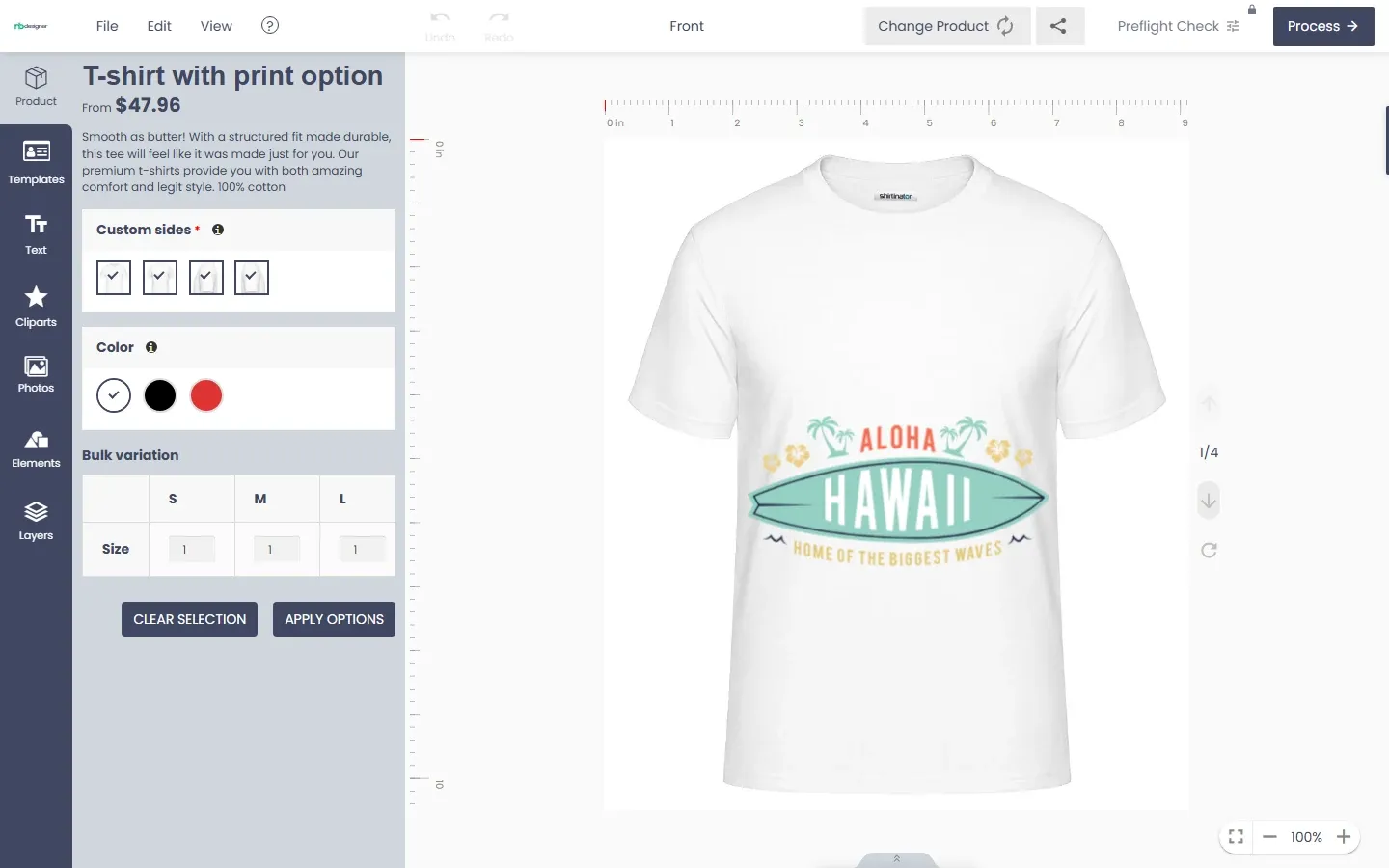
Consider a T-shirt seller testing two product descriptions or design options. Compare product-page engagement, completed orders, returns and customer feedback before deciding which option to keep.
Benefits of E-commerce for Direct-to-Consumer Brands
D2C ecommerce offers more control over the storefront and customer journey. Each benefit has a cost or operational condition to check:
Greater Market Reach: An online catalog can be visible beyond a local shop, provided the brand can support shipping, tax, language and service in the target market.
Higher Margins: Direct sales remove some intermediary fees but add acquisition, payment, fulfillment, returns and support costs. Compare contribution margin by channel.
Control Over Customer Experience: The brand can choose product information, checkout and follow-up messages. Test whether shoppers can find answers and complete orders.
Data-Driven Insights and Personalization: With correctly configured analytics and consent, the brand can examine product views, cart actions, purchases and repeat orders before changing content.
Scalability and Flexibility: Platforms such as WooCommerce and Shopify support different store setups; test integrations, operating cost and capacity against actual requirements.
For a limited skincare launch, record the offer, traffic source, inventory and first-order cohort. Report sell-through and later repeat purchases only after those numbers can be tied to a named, permission-cleared example.
Explore more:
Cmsmart Web to Print Solutions
Cmsmart T-shirt Design Demo
Cmsmart marketplace setup service
Cmsmart YouTube: E-commerce Product Customization
Forbes: The Rise of D2C
Operational Advantages of a D2C Store
The practical value of ecommerce depends on the brand's channel mix and operating model. The next checks help separate a useful direct channel from an unsupported growth promise:
Pandemic Resilience and Digital Transformation: The COVID-19 period exposed the need for remote ordering and resilient fulfillment. The linked McKinsey discusses digital change; document which ordering and delivery steps your business can actually operate.
Integration with Digital Marketing Channels: Connect campaign links and permitted customer data to store measurement. Google Ads, Facebook Ads and Mailchimp are channel options; verify consent, tracking and cost before adopting each one.
Global Reach with Localized Strategies: Check currency display, payment availability, shipping rules, taxes and customer support by target region before launching cross-border sales.
Agility and Innovation: Test one product or message change at a time, then compare customer feedback and order outcomes with a recorded baseline.
For an in-depth look at D2C growth, explore related resources:
Cmsmart Web to Print Solutions, T-shirt Design Demo, Community SEO Tutorials, and E-commerce Customization Demo
Opportunities E-commerce Offers to D2C Brands
A D2C store can support several channel and product experiments. Select only those that fit the customer task and the team's ability to fulfill orders:
Social Commerce and Influencer Marketing: A brand can send shoppers from social posts or creator partnerships to a product page. Record campaign cost, attributed orders and returns before judging the partnership.
Personalized Customer Journeys: Consider recommendations or loyalty offers only when customer data, consent and the expected task justify them. Compare results with a simpler default journey.
Subscription Models: Recurring purchases may fit replenishable goods. Model opt-in, cancellations, stock, billing and support before forecasting retention.
Innovative Payment and Delivery Options: Offer methods that match buyer needs and available integrations. Compare completion, fees, disputes and delivery exceptions.
Practical Strategies for D2C Brands to Maximize E-commerce Benefits
Start with a measurable customer or operating problem. These actions turn broad D2C ideas into testable work:
Invest in Data-Driven Decision Making: Configure ecommerce events and compare product views, carts, purchases and refunds alongside CRM and support records.
Optimize for Mobile Commerce: Test product discovery, variant selection, payment and confirmation on representative phones and connections.
Enhance Product Discovery and Personalization: Check whether filters, clear product information and search solve the problem first; test recommendations only with a defined data and acceptance plan.
Build Strong Customer Communities: Use a channel customers already use, assign a response owner and review recurring support questions.
Implement Sustainable Practices: Describe sourcing, packaging or certification only when the brand has records to substantiate each claim.
Test and Iterate: Choose a baseline and one primary measure before testing a landing page, email or promotion.
How to Measure D2C Ecommerce Results
The following are evaluation scenarios, not published customer case studies. A named outcome requires a source record and permission to use the customer's identity and metrics.
For product customization or order workflows, review Cmsmart Web to Print Solutions and Cmsmart’s community e-commerce strategies. Confirm the exact feature, integration and operating scope before applying either example.
External Resources for Further Exploration
These resources can help plan an owned storefront and its measurement. Verify each product's current scope before choosing a tool:
Shopify Plus: Advanced D2C Strategies
BigCommerce: D2C Growth Insights
Cmsmart Web to Print Solutions for a print-customization solution overview
Cmsmart Community E-commerce Strategies for related articles and discussion
Printcart: Web to Print API & Order Management
WooCommerce: D2C Store Customization
Klaviyo: Email and SMS Marketing Automation
Yotpo: Customer Reviews and Loyalty Programs
Zendesk: Scalable Customer Support Solutions
Google Analytics: Data-Driven Insights
Conclusion: Evaluate Your D2C Channel
An owned ecommerce channel gives a D2C brand more control over product information, checkout and customer service. Its value depends on acquisition cost, fulfillment, returns and repeat orders, so compare these measures with the current channel mix.
Key takeaways:
Compare tools against your D2C requirements, including Cmsmart Web to Print Solutions and Printcart's Web to Print API only when print customization or API integration is in scope.
Compare ecommerce events, customer feedback and campaign cost before changing the offer or the store journey.
Choose a customer community or social channel the team can support, then review recurring questions and attributed orders.
Use these next-step links to inspect relevant solution and example pages.
Choose Your Next D2C Ecommerce Step
Choose a next step based on the customer task: review a relevant solution, test an example product, or document the integration questions for a scoped discussion:
Review Cmsmart Web to Print Solutions for print customization use cases.
Read Printcart’s Web to Print API & Order Management and verify API and order-management scope before planning an integration.
Try Cmsmart T-shirt Design Demo as a product-design example; it does not document a customer outcome.
Join the Cmsmart Community for insights and expert discussions.
Watch Cmsmart YouTube for tutorials and product demonstrations; verify current behavior in the product itself.